Department chair's book on 1990s textile art honored with prestigious award
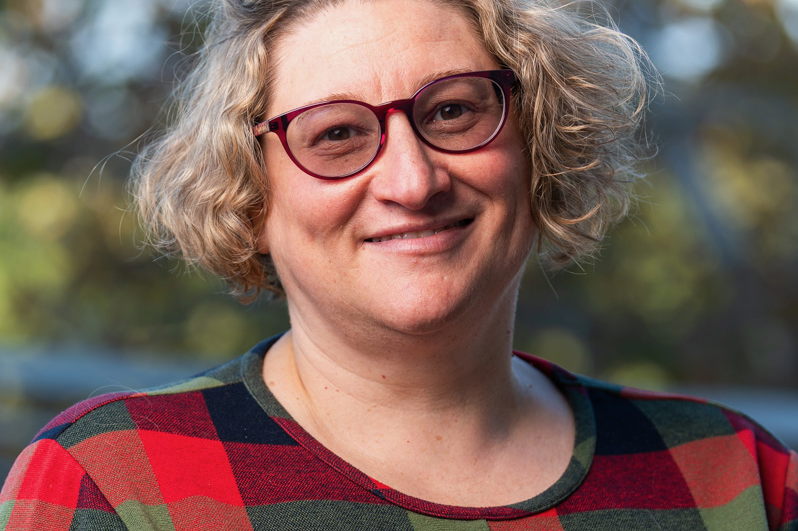
Jenni Sorkin, professor and chair of UC Santa Barbara's Department of History of Art and Architecture, has been named a 2025 grantee of the Andy Warhol Foundation Arts Writers Grant. The award supports her book-in-progress, “Deviant Scale: Cloth at the Body's Margins,” a critical re-evaluation of textile-based art production in the United States between 1985 and 2000.
Sorkin’s work challenges the New York-centric narrative of the art world. She argues that during the 1990s, while New York galleries prioritized solo exhibitions, a “parallel world” of regional group exhibitions emerged across the country. These non-commercial, thematic shows became vital spaces for women and artists of color to experiment with identity-driven practices.
“Deviant Scale” explores how cloth became a primary medium for deconstructing race, gender, sexuality, mobility and disability. In regions constrained by social or cultural conservatism, the immediacy of textiles allowed artists to create large-scale installations and mixed-media sculptures that evoked the body through folding, stacking and sewing.
The Andy Warhol Foundation Arts Writers Grant has funded over 450 writers in 20 years, providing more than $13.5 million in support. The program aims to ensure that critical writing remains a valued mode of engaging with the visual arts. The 2025 cycle awarded $1,040,000 to 31 writers, with individual grants ranging from $15,000 to $50,000.
“The Arts Writers Grant honors excellence in the field, and celebrates the generative role arts writing plays in creative and intellectual spheres,” said Joel Wachs, president of the Andy Warhol Foundation for the Visual Arts.
Sorkin is the author of “Live Form: Women, Ceramics and Community” (2016) and “Art in California” (2021). She has published widely as an art critic in Artforum, Frieze and Art Journal, and serves as co-executive editor of the peer-reviewed, open-access journal Panorama: Journal of the Association of Historians of American Art.
As Sorkin notes, “This grant offers me the ability to complete the research portion of this book: I have many living artists and curators to see and talk to all over the country, not just in big cities like New York or LA, but in the regional spaces that do crucial work in their communities to support artists and offer new ideas to their audiences, such as Des Moines, Iowa and Winston-Salem, North Carolina.”